
Walk a Zion Street Record
An address search works best when each source answers one narrow question. Lake County property records establish the parcel and indexed owner. The map sets that parcel beside the next lots. Recorded deeds show how title moved, while a lawful voter-list channel or an older reverse directory may add time-specific evidence of people connected to the address. None of those sources alone is a full household list.
Follow the evidence in order. Keep the exact street spelling and save the parcel identification number, or PIN, as soon as it appears. A PIN is the county's stable parcel key. It helps prevent two similar house numbers from being mixed up.
- Enter the house number and street in the Lake County Property Tax Information search. Use one main search parameter and leave the direction out of the Street Name field.
- Record the Zion situs address, PIN, legal description, current owner, billing destination, and transfer history. Treat situs as the taxed location, not as proof of a household.
- Open the Lake County Tax Parcel Viewer. Zoom to the lot and click nearby parcels when the goal is a street segment.
- Use the owner and transfer record in Land Records eSearch. Search the buyer as grantee, then follow the seller backward through prior deeds.
- For a past occupant, ask Zion-Benton Public Library about reverse directories and telephone books. For voter data, use only the election authority's individual or statutory process.
This order keeps ownership, occupancy, and mailing facts separate. It also gives the Zion street directory a clear audit trail when a name or address changes.
Search Zion Streets in Tax Records
The county tax portal is the strongest first stop for a current Zion address. Its Basic Search separates the number, direction, street name, street type, and unit. That design matters on Zion's mix of numbered streets and named roads. The portal directs users to search with one principal parameter, so an address search should not be crowded with an owner or PIN at the same time.
| Search field | Input | How Zion searches use it |
|---|---|---|
| Parcel ID | Numbers without dashes | Use alone once the PIN is known |
| Owner | Last Name, First Name | End wildcard is assumed; an internal * is allowed |
| Billing Name | Name text | Separate from the indexed owner |
| Address No | House number | Pair with the street field |
| Street controls | Direction, name, type | Do not put the direction inside Street Name |
| ZIP Code | Postal code | Broader property search, not a resident roster |
| Tax year | Year selector | Changes the year of the displayed record |
Results can expose the PIN, owner, situs, billing detail, legal description, values, exemptions, and conveyance history. The linked tabs reach profile, map, tax status, current and historical values, building details, and transfers. Those fields support a street-by-street study without pretending the roll names every resident.
See a real portal view through the Lake County parcel record display.
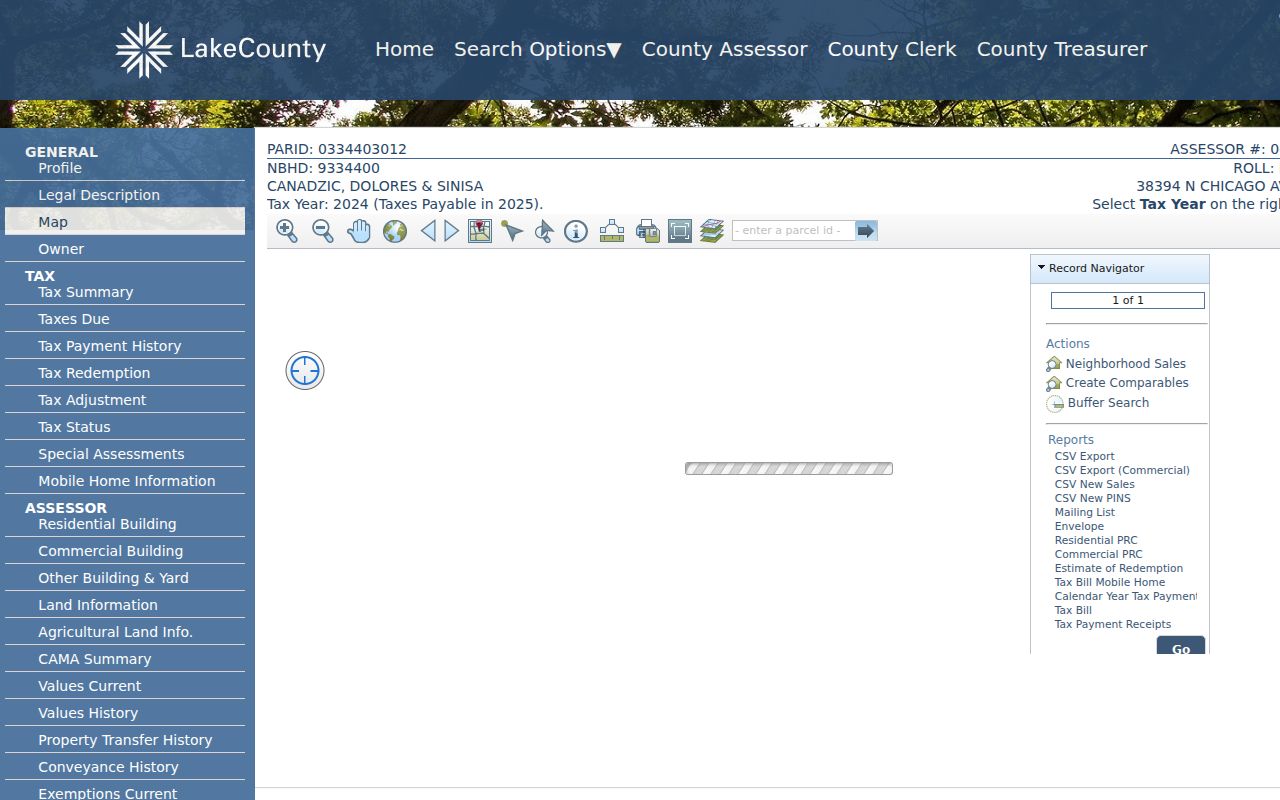
The screen shows why a Zion address lookup should capture record year and parcel details before moving to another source.
Zion Records Indexed by Address
Each address-keyed source has a different keeper and a different blind spot. The table below shows the channels documented for Zion and Lake County. When an online search fails, use the stated counter or written-request path rather than assuming no record exists.
| Address source | What it can establish | Access path | Main limit |
|---|---|---|---|
| Property tax roll | Owner, billing destination, situs, PIN, values and transfers | Free county portal | Owner may not live there |
| Tax Parcel Viewer | Lot shape, address labels, roads, subdivision and nearby parcels | Free visual map | Not a legal survey |
| Recorded land records | Deeds, liens, releases, plats and prior owners | eSearch, older index books, public terminal, phone, email or mail | Old address indexing is incomplete |
| Zion permit and code files | Applicant, contractor, work, inspections and disposition | Written city request by email, mail or in person | Applicant is not necessarily occupant |
| Voter information | Individual status or permitted list data | State identity lookup or election-law process | No public street-browse tool |
| Reverse directories | Dated occupant or subscriber by house number | Library databases and genealogy appointment | Exact Zion year run is not published online |
Parcel and deed records join most cleanly through the PIN, legal description, owner, and conveyance date. A street name may connect city files and a reverse directory, but spelling and direction must be checked in the source itself.
Note: Lake County forbids automated extraction from its tax site, so browse, search, and use authorized downloads instead of scraping records.
Map Zion Parcels Along Streets
The Tax Parcel Viewer turns one result into a visual street directory. Search by address or PIN, zoom until parcel lines and address labels appear, then use identify tools on consecutive lots. Available layers include lot and subdivision lines, road labels and centerlines, address labels, condominiums, historic tax map images, and public or private rights-of-way.
A parcel is a mapped unit of land used in assessment. A plat is a recorded drawing that lays out lots, blocks, streets, or a subdivision. Neither automatically proves the location of a fence or settles a boundary dispute. For owner details, move from the selected polygon back to the property-tax record.
Lake County has rebuilt the viewer on a newer technology platform. The map remains suited to visual, click-by-click research. The Lake County Mapping Division also maintains PINs, address data, district boundaries, and historic parcel resources, and can be reached at 847-377-2373.
Three Zion Address Identities
A common street-directory mistake is treating every address field as the same fact. In the assessment record, the situs address locates the taxed parcel. The billing or mailing address tells where tax correspondence goes. A legal description identifies the land in recorded terms such as subdivision, block, and lot.
- Situs address
- The physical parcel location used in the county assessment system.
- Billing address
- The destination for the tax notice, which may belong to an owner, trust, firm, or manager elsewhere.
- Legal description
- The recorded words that identify land independently of a current mailing label.
- Criss-cross directory
- A directory arranged by street and house number, reversing the usual name-first order.
A matching billing and situs address can support owner occupancy, but it does not prove it. A different billing destination is useful evidence about tax correspondence, not proof that the owner lives at either address. Renters and other members of a home do not appear on the parcel roll.
Note: Illinois tax year and payable year differ, so record both labels when comparing a Zion owner or value across years.
Follow Zion Owners Through Deeds
The Lake County Clerk's Recording Division holds Zion deeds, mortgages, releases, liens, plats, annexations, and other instruments. Structured electronic indexing starts in 1980, while older searches move into Online Index Books. The holdings themselves reach 1844. The 136-year gap between first holdings and the electronic cutoff is a change in search method, not a loss of the record series.
Name searching is the official primary method. Start with the current buyer as grantee, the person receiving an interest. Then search the seller, or grantor, as an earlier grantee. Preserve the legal description and document number at each turn. Older instruments may not have a PIN and may not be reliably indexed by property.
The recorder documents a useful index quirk. Less text may find more name variants, and a percent sign can bridge an abbreviation. The Show Names List feature helps compare indexed forms before choosing one. This matters when a Zion street directory trail crosses old spellings or abbreviated institutional names.
Review the county's recording search and copy answers before ordering an image.
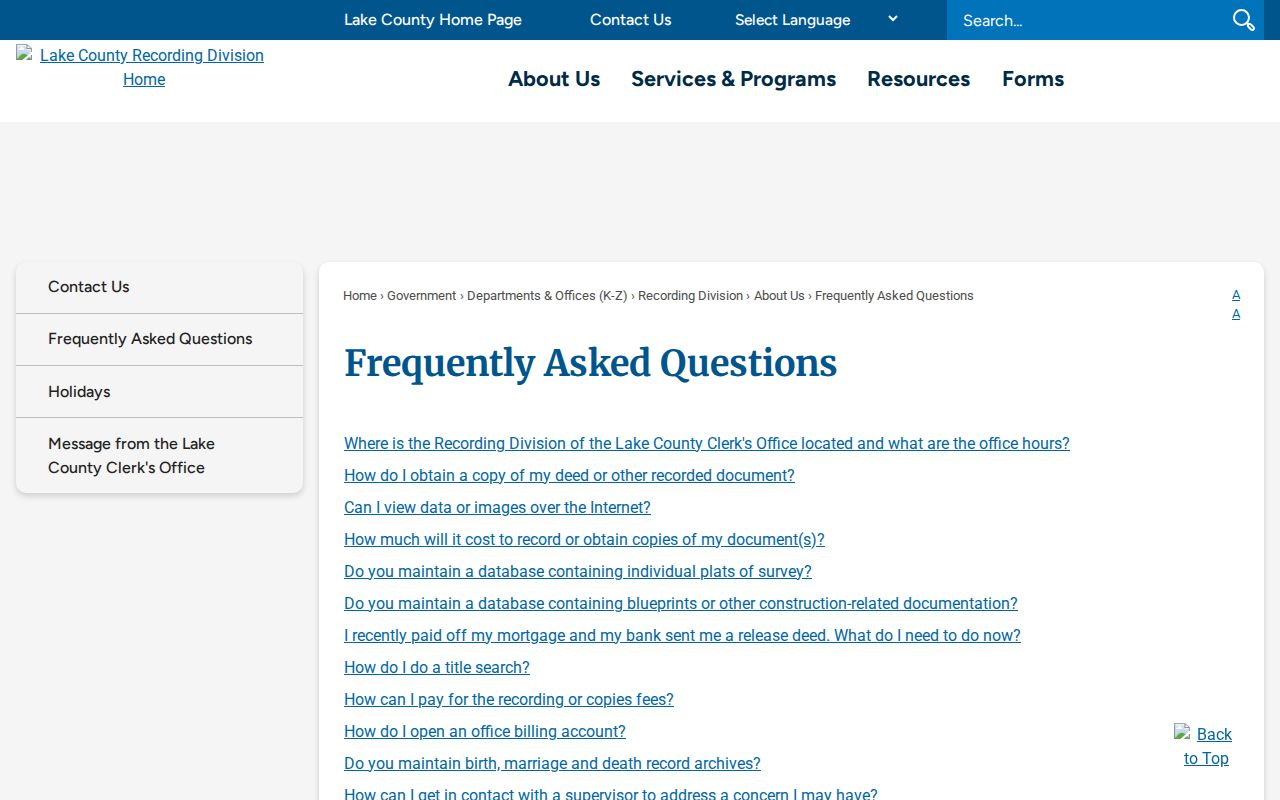
The county guidance points researchers to the direct copy channels that remain available when portal access is not the best fit.
Zion Deed Access Beyond eSearch
Online land-record access requires registration and a subscription. It is not the only route. The Recording Division keeps free public terminals at 18 N County Street, sixth floor, Waukegan. Staff can help with the terminal, although they cannot perform or guarantee a title search.
Copies may be ordered in person, by telephone, mail, fax, or email. The office is open weekdays from 8:30 a.m. to 5:00 p.m.; the phone is 847-377-2575 and the published email is recorder@lakecountyil.gov. Recorded-document copies cost $1 per page, while other products and certifications have separate fees. For one known deed or release, direct contact may be simpler than broad online access.
Individual plats of survey and building blueprints ordinarily are not recorded. Ask for the recorded subdivision plat, deed, or other named instrument that the index identifies. That wording helps keep an order within the records the office actually holds.
Request Zion Files by Street
Zion does not publish a dedicated searchable permit database in the research record. The fallback is a narrow written request to the City Clerk. Ask for existing documents, not an explanation. Include the street number, exact spelling, an approximate date range, and each wanted category, such as an application, issued permit, contractor identification, inspection log, certificate of occupancy, or code-case disposition.
Zion's FOIA request page accepts written city requests in person, by mail, or by email. City Hall is at 2828 Sheridan Road, and the principal municipal contact is City Clerk Sheryl Spooner. Fire and police records use separate channels shown on the city page. Ordinary noncommercial requests generally receive a response within five business days, subject to a lawful extension.
Permit evidence is dated and useful, but the named applicant may be an owner, contractor, or agent. A code complainant may also be withheld. Keep those roles clear when adding city records to a by-address trail.
Read Older Zion Streets in Reverse
Historical reverse directories turn a street and house number into the occupant or telephone subscriber printed for that edition. Zion-Benton Public Library confirms access to genealogy databases with city-directory content, but it does not publish an exact Zion volume run online. Do not assume a publisher or a continuous set of years.
The practical channel is the Zion-Benton genealogy service. Adult Services schedules Zion Genealogical Society help on Tuesdays and Saturdays. Ask staff to check reverse directories, telephone books, yearbooks, and clipping files for a precise year and street spelling. The Zion city directory collections are covered in depth on the historical shelf page.
Exact street forms matter. Zion's planned-community history produced biblical street names alongside numbered streets and major named roads. No official citywide renumbering date was found. When an old and new address do not line up, compare plats, legal descriptions, maps, and city ordinances before deciding that a household moved.
Zion Voter Data Is Not Browsable
The Illinois registration lookup lets one voter verify a record through identity information. It does not accept an address and return everyone on a Zion street. Lake County voter lists are governed by election law, not ordinary FOIA.
Lake County permits inspection of registration and voting-history material under its statutory process. Electronic person-level exports are limited to qualified political committees or governmental entities for authorized informational purposes. Printed lists may be sorted in numeric street order through the lawful channel. The voter record can show participation history, but never ballot choices.
For a general street study, the open parcel and GIS sources should lead. Use voter evidence only when access is permitted and the source supports the limited point being made.
Limits of a Zion Street Directory
No public Zion street directory provides a complete list of renters, children, lodgers, or every other household member. Motor-vehicle address data is restricted by federal law. Utility, delivery, and protected-program addresses also stay outside this method. Recorded owners may be trusts, firms, public bodies, or lenders rather than people at the door.
Use the least amount of personal detail needed for family research, property history, civic questions, or scam checking. Correct an error with the office that created the record. The Illinois Attorney General's Address Confidentiality Program provides a substitute address and mail forwarding for eligible survivors, and protected locations should never be rebuilt by joining public sources.
Lawful use. Zion address records support legitimate personal research, but Illinois law does not permit stalking, threats, harassment, or intimidation.